Discovering Salento, the Soul of Southern Apulia
Few regions in Italy capture the imagination quite like Apulia (Puglia). Bordered by the Adriatic Sea to the east and the Ionian Sea to the west, Apulia’s beauty lies not only in its landscapes but also in its diversity. Yet, it is in the southernmost tip of Puglia — the Salento Peninsula — that the region’s heart beats strongest. With its blend of ancient traditions, pristine beaches, and a culture deeply connected to the land and sea, Salento is where Italy feels both timeless and vividly alive.
What Is Salento and What Makes It Special
Geographically, Salento stretches from the city of Brindisi down to Santa Maria di Leuca, the southernmost point where the Adriatic Sea and the Ionian seas meet. Historically, it has been a crossroads of civilizations — Greeks, Romans, Byzantines, Normans, and Spaniards all left their mark here. This fusion of cultures is visible in everything from the region’s architecture to its language and music. In the villages of Grecia Salentina, for instance, some locals still speak Griko, an ancient Greek dialect that has survived for centuries.
The Most Beautiful Places to Visit in Salento
What makes Salento so unique is its authenticity. Despite its growing popularity among travelers, it remains deeply tied to its roots. Here, time moves more slowly. Locals gather in the piazza for evening strolls, fishermen mend their nets at dawn, and baroque churches rise beside olive fields. The light, the warmth, the rhythm of daily life — everything in Salento seems designed to make you slow down and savor the moment.
Lecce, the Baroque Jewel of the South
The capital of Salento, Lecce, is a city of golden stone and intricate beauty.
Often compared to Florence for its artistic richness, Lecce’s identity is defined by its Baroque architecture, locally known as Barocco Leccese. The soft limestone of the region allowed artisans to carve incredibly detailed facades that shows cherubs, vines, angels, and mythological creatures.
Don’t miss the Basilica di Santa Croce, a masterpiece of decorative art, and the Piazza del Duomo, one of Italy’s most harmonious squares. The city’s ancient Roman amphitheater, partially buried under modern streets, speaks of its long history. Lecce is also alive with culture — craft shops, art galleries, and vibrant festivals fill its narrow streets, especially on summer evenings.
Otranto: Where East Meets West
Perched on the Adriatic coast, Otranto is Italy’s easternmost town and one of its most fascinating. Its whitewashed walls and turquoise harbor recall Greece, yet its history is distinctly Italian. The medieval Cathedral of Otranto is home to a stunning 12th-century mosaic floor, depicting scenes of heaven, earth, and mythological creatures, which is considered a masterpiece.
Nearby, the Aragonese Castle overlooks the sea, a reminder of the city’s strategic importance through the centuries. Otranto also boasts some of the most spectacular beaches in Salento, including Baia dei Turchi and Porto Badisco, both framed by cliffs and crystal-clear waters.
Gallipoli, the Pearl of the Ionian
On the opposite coast lies Gallipoli, whose name means “Beautiful City” in Greek — and rightly so. The old town sits on a small island connected to the mainland by a 17th-century bridge, surrounded by turquoise water. Within its labyrinth of alleys, you’ll find whitewashed houses, hidden courtyards, and centuries-old churches.
The Cathedral of Sant’Agata, with its richly decorated facade, dominates the skyline, while the fish market by the port buzzes with life each morning. Gallipoli is also known for its lively summer nightlife, beach clubs, and sunsets over the Ionian Sea that seem to set the whole horizon aflame.
Santa Maria di Leuca: The End of the Land
At the southern tip of Puglia lies Santa Maria di Leuca, where the Adriatic and Ionian seas meet. The town has long been a place of pilgrimage — its Sanctuary of Santa Maria de Finibus Terrae (“at the end of the land”) sits dramatically above the sea, next to a 19th-century lighthouse.
From the cliffs, you can look down on the caves and grottoes carved into the rock, many of which can be explored by boat. The town’s elegant 19th-century villas, built by noble families as summer residences, add a touch of faded grandeur to the landscape.
The Beaches of Salento: A Tale of Two Seas
Salento’s coastline offers a dazzling variety of beaches, from the wild, rocky coves on the Adriatic side, to the wide, golden shores on the Ionian side.
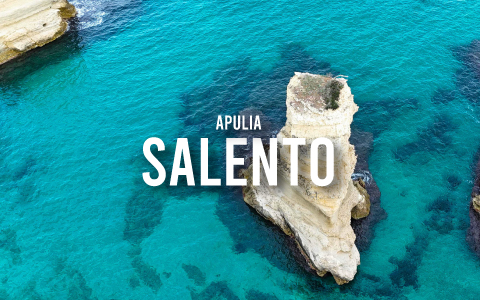
On the Adriatic, don’t miss the Grotta della Poesia near Roca Vecchia, a natural pool carved into the rock where swimmers dive into translucent blue water. Torre dell’Orso and Sant’Andrea are famous for their cliffs and sea stacks, sculpted by wind and waves.
On the Ionian side, the atmosphere softens, the beaches are long and sandy, and the sea is calm and clear. Punta Prosciutto, Torre Lapillo, and Pescoluse (often called “the Maldives of Salento”) are among the most stunning in Italy, perfect for long swims and lazy afternoons.
Activities and Experiences in Salento
There’s no shortage of ways to experience Salento beyond sightseeing.
Boat Trips
Explore the coastline by sea, discovering caves, hidden coves, and swimming spots accessible only by boat. Sunset cruises are especially magical, with the sky turning pink and gold over the Ionian Sea.
Cycling and Hiking
The flat terrain and scenic countryside make Salento ideal for cycling. Routes wind through olive groves, vineyards, and ancient dry-stone walls. Coastal paths near Otranto and Leuca offer breathtaking views.
Festivals and Traditions
Summer in Salento is a season of celebration. The most famous event is La Notte della Taranta, a music festival dedicated to the traditional pizzica dance — a hypnotic rhythm born from ancient healing rituals. Local patron saint festivals fill towns with lights, fireworks, and processions.
Wine and Olive Oil Tastings
Visit local farms to sample Primitivo and Negroamaro wines, or taste freshly pressed olive oil from centuries-old trees. Many masserias (traditional farm estates) offer guided tastings and rustic lunches.
The Flavors of Salento: A Cuisine of Simplicity and Soul
No journey through Salento is complete without indulging in its food.
Born from peasant traditions, Salento’s gastronomy transforms simplicity into art.
Start with friselle, crunchy barley or wheat rings soaked briefly in water and topped with tomatoes, olive oil, and oregano. Orecchiette, the iconic “little ear” pasta, is often served with turnip tops (cime di rapa) or rich tomato sauces.
Seafood lovers will find paradise here: grilled octopus, fried anchovies, mussels, and swordfish are staples of the coastal menu. Inland, you’ll find hearty dishes like fave e cicoria (mashed fava beans with chicory) and rustico leccese, a flaky pastry filled with mozzarella and béchamel.
To finish, try a pasticciotto, a warm pastry filled with custard best enjoyed with a strong caffè leccese, an espresso poured over ice and sweetened with almond milk. It’s the taste of summer in a glass.