
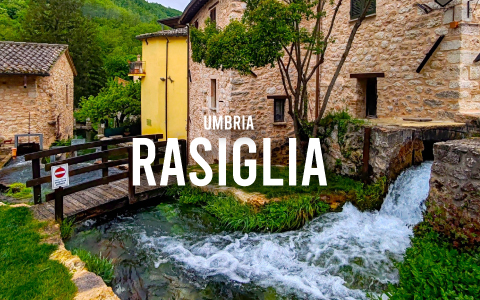
Things to See and Do in Rasiglia, Umbria
Often called the “green heart of Italy”, Umbria is characterized by rolling hills, olive groves, vineyards, forests, the dramatic peaks of the Apennines and historic cities such as Perugia, Assisi, Spoleto and Orvieto. It has a bit of a Tuscan feel, but it is wilder and full of natural beauty, such as the spectacular Marmore Falls. Moreover, Umbria’s greatest treasures are found away from its most famous destinations. Throughout the region, small medieval villages preserve stone houses, ancient churches, castles and traditions that have survived for centuries. One of the most fascinating is Rasiglia, often referred to as the “Village of Water”.
A Brief History of Rasiglia
The history of Rasiglia is closely connected to its strategic position in the mountains and, above all, to the abundance of water in the area.
The settlement developed during the Middle Ages in the Menotre Valley, in a position that allowed it to control routes through the surrounding mountains. During the period when the Trinci family dominated Foligno, Rasiglia acquired greater strategic importance and defensive structures were established on the hill above the settlement.
Water gradually became the foundation of the local economy. Springs provided a reliable source of energy for mills and workshops, allowing inhabitants to process grain and develop textile and wool-related activities. This economic role continued into more recent centuries, particularly with the development of textile production.
Like many small mountain communities in Italy, however, Rasiglia subsequently experienced economic decline and population loss. The devastating earthquake that affected Umbria in 1997 also damaged buildings in the village. However, the restoration of Rasiglia and growing interest in its unusual landscape have since helped transform it into one of Umbria’s most interesting small villages to visit.
What to See in Rasiglia
Rasiglia is one of the most unusual villages in Umbria because its identity is built around something that is normally hidden from view: water. It is small, peaceful and easy to explore, yet its medieval history, historic mills and textile heritage give it much more depth than its size might suggest.
There is no need for an elaborate sightseeing plan. Rasiglia is small and best discovered by wandering through its lanes, crossing its bridges and following the streams from their sources through the historic centre.
The Waterways and Small Bridges
The first thing visitors notice when arriving in Rasiglia village is the sound of running water. Small streams cross the settlement in several directions, flowing beside stone houses, underneath tiny bridges and through channels constructed over the centuries. In some places the water collects in small pools; elsewhere it creates miniature cascades before continuing downhill. Rasiglia is sometimes compared with Venice because of its waterways, but the similarities end there.
The architecture is typically Umbrian, with stone walls, narrow lanes and modest medieval buildings. Moss, vegetation and water soften the grey tones of the stone, giving the village a particularly peaceful appearance.
Capovena Spring
The Capovena Spring is one of the most important places to see in Rasiglia because it explains the reason behind the village’s unusual appearance.
The spring rises in the upper part of the settlement and feeds the waterways that subsequently run through Rasiglia. Following the water from this point provides a fascinating introduction to the hydraulic system that historically allowed the community to use the natural resource for agriculture and industry.
Rather than treating the spring as an isolated attraction, visitors should use it as the starting point for exploring the rest of the village. The streams gradually reveal how closely the houses, streets and workshops were connected to the water.
The Historic Mills and Rasiglia’s Textile Heritage
For centuries, the energy generated by flowing water was used to power mills and workshops.
Among the village’s historic structures are old mills that demonstrate how the inhabitants adapted their environment to support the local economy. The Mulino Silvestri is one of the sites associated with this industrial heritage.
During the 19th and early 20th centuries, the textile industry became particularly significant for the local economy. Today, surviving machinery and restored structures offer an insight into this forgotten side of village life. Among the historic elements to visit are the former Accorimboni wool mill and an old Jacquard loom.
The Ruins of Rasiglia Castle
Above the village are the remains of its medieval castle, another attraction worth discovering.
Only parts of the defensive complex survive, but the ruins help explain why Rasiglia developed in this particular location. From the elevated position, the settlement and surrounding valley could be monitored, making the castle an important element of the village’s medieval defensive system.
The castle ruins are less immediately spectacular than the streams below, but they add historical depth to a visit and are particularly worthwhile for travellers interested in medieval Umbria.
Things to Do in Rasiglia
The best activity is simply walking around Rasiglia. Follow the streams and explore the narrow streets around the historic centre. Take your time rather than trying to see everything quickly.
Photography is another obvious activity. The combination of water, stone architecture and mountain vegetation makes the village particularly photogenic. Early morning or late afternoon can be especially pleasant, when the light is softer and the village tends to feel quieter.
Food lovers can also use their visit as an opportunity to discover traditional Umbrian cuisine. Local restaurants serve regional specialities based on ingredients such as truffles, mushrooms, legumes, meat and handmade pasta.
Throughout the year, Rasiglia also hosts events connected with its traditional culture. Among the best-known is Penelope a Rasiglia, an event dedicated to weaving and textile craftsmanship. During the Christmas period, the village also becomes the setting for a traditional living nativity scene.
What to See Near Rasiglia
A visit to Rasiglia can easily be combined with other attractions in central Umbria.
The first nearby destination is Foligno. Its historic centre offers a completely different urban experience, with palaces, churches and museums providing a useful contrast to Rasiglia’s intimate mountain atmosphere.
Nature lovers can explore the Menotre Valley and its waterfalls, where the presence of water remains a recurring theme. The nearby Abbey of Sassovivo, set in a wooded landscape outside Foligno, is another worthwhile stop for travelers interested in medieval architecture and religious history.
Rasiglia can also be incorporated into a wider itinerary through eastern Umbria. Assisi, Spello and Trevi are all within reach by car and offer some of the region’s most impressive historic landscapes.
This makes the village particularly convenient if you are planning an Umbria road trip rather than a standalone excursion.
How to Get to Rasiglia from Umbria’s Main Cities
The easiest way to reach Rasiglia is by car.
From Foligno, the village is approximately 17 km away. From Perugia, the drive generally takes around an hour, depending on traffic and the route selected. Alternatively, from Assisi or Spoleto it takes about 30-40 minutes.
When driving, it is important to remember that the final roads into the mountains can be winding. Some navigation apps may suggest narrower alternatives, so following the main recommended access route is preferable.
Once you arrive, leave the car in the designated parking areas and continue on foot. Rasiglia’s greatest attractions are concentrated within the pedestrian-friendly village, where walking is the best way to appreciate the waterways.


